My goal is always to represent the horse world as accurately as possible, and as my regular readers know, I’m always asking for help to do that. I spend a lot of hours researching and putting together the articles (and pages) I write to be informative, educational and fun.
I’m No Geneticist
I will, however, make mistakes from time to time and that is where I count on the equine experts and community to help me by letting me know if my information is incorrect. Feedback is always appreciated because it never fails to teach me something new and it means that my website is kept up-to-date and accurate.
Called Into Question
It has come to my attention (through a comment) that my post on rare horse colors may not provide complete information. When I read the comment I quickly re-checked my facts to ensure I hadn’t been mistaken.
Getting the Facts Straight
I wanted to address this right away, especially because horse color genetics are often misunderstood (& misrepresented) and the research available online is limited at best. If anyone has better information and/or a great source for it, please let me know.
I’m glad to have the feedback, but I’ll have to stand by my information this time.
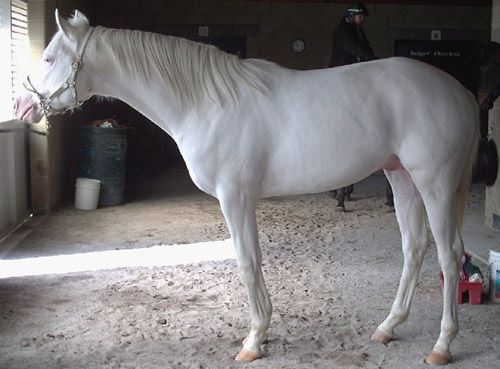
The pure albino gene is fatal in horses, they do not develop properly in utero. If they do survive until birth, they die shortly thereafter
You can read more about the genetics that create an albino horse at White Horse Productions, Texas A&M University, and from Jeff Sadler who teaches biology and has a great grasp of equine genetics.
My research on white horses has been difficult. What most people call a “white” or “albino” horse (pink skin and blue eyes) is usually a cremello or perlino. This is a chestnut base affected by a double dose of the creme dilution gene.
I don’t like linking to the Wikipedia for information, so I’m not sure of its validity, but they discuss a “true white” horse which is very rare. My understanding is that a white animal can carry a white gene, and pass it to their offspring. It takes two parents with said white gene to (rarely) produce a pure albino which will not survive.

There are two different types of black horses, fading black and non-fading black. Fading black horses will fade out with age. However a non-fading black horse retains their deep black color throughout their life and they are indeed rare.
You can find more about black horse genetics on horsecolor.com
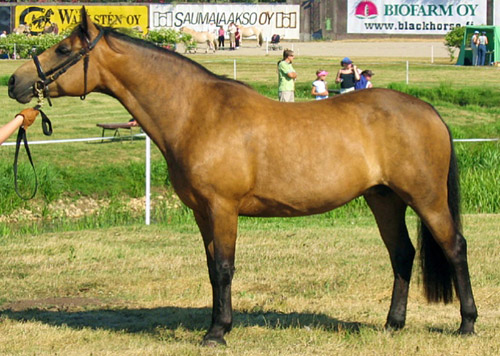
Buckskin coloring comes from the addition of a creme dilution gene on a bay and even a single dilution of a creme gene can produce blue eyes.
They are also a rare color because they are reliant on the creme gene which is elusive and can be difficult to reproduce, even if both parents carry it.
You can read more about buckskin horse genetics on Horse Info and ehow advice.
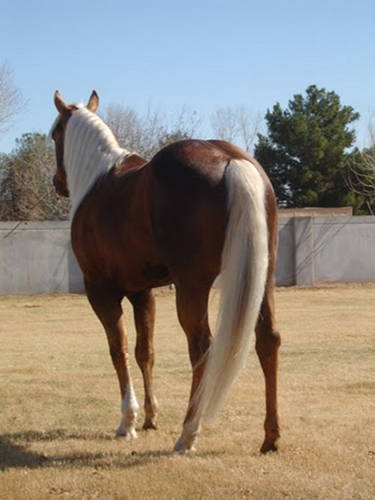
A chocolate palomino is usually the result of a paring between a palomino and a liver chestnut animal and is actually considered a palomino because it is created by the creme dilution gene.
You can read more about palomino color genetics at Horse Genetics
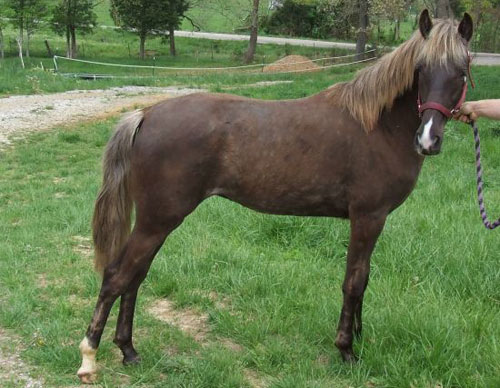
The silver dapple color is a result of a silver dilution gene on a black base and it is indeed a rare color. Gaited and mountain breeders call it chocolate and Icelandic breeders call it blue silver.
You can find more information about the genetics of silver dapple (and other silver colors) at Equine Color.
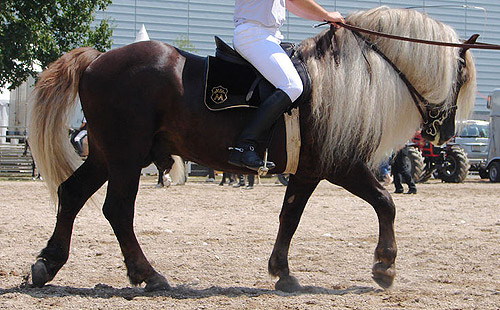
A flaxen chestnut is a horse with a chestnut base affected by a flaxen color modifier which turns the mane and tail flaxen in color. This color modifier only affects chestnut animals & is still a mystery gene that is believed to be recessive (needs both parents to carry it for it to be displayed in offspring). This modifier is commonly found in Haflinger horses
Unfortunately there is limited information to link to here, the flaxen modifier is touched upon but not much is known about it.
Disagree?
That’s what the comments are for. If you can prove my research wrong, by all means show me so I can amend my information.