My goal is always to represent the horse world as accurately as possible, and as my regular readers know, I’m always asking for help to do that. I spend a lot of hours researching and putting together the articles (and pages) I write to be informative, educational and fun.
I’m No Geneticist
I will, however, make mistakes from time to time and that is where I count on the equine experts and community to help me by letting me know if my information is incorrect. Feedback is always appreciated because it never fails to teach me something new and it means that my website is kept up-to-date and accurate.
Called Into Question
It has come to my attention (through a comment) that my post on rare horse colors may not provide complete information. When I read the comment I quickly re-checked my facts to ensure I hadn’t been mistaken.
Getting the Facts Straight
I wanted to address this right away, especially because horse color genetics are often misunderstood (& misrepresented) and the research available online is limited at best. If anyone has better information and/or a great source for it, please let me know.
I’m glad to have the feedback, but I’ll have to stand by my information this time.
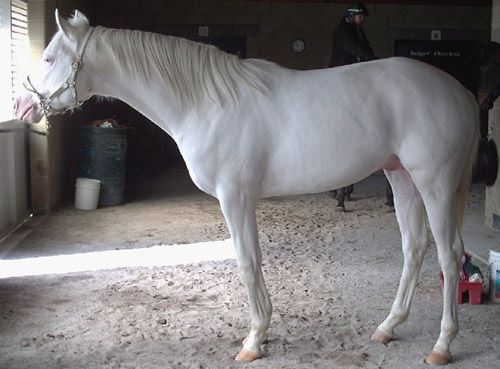
The pure albino gene is fatal in horses, they do not develop properly in utero. If they do survive until birth, they die shortly thereafter
You can read more about the genetics that create an albino horse at White Horse Productions, Texas A&M University, and from Jeff Sadler who teaches biology and has a great grasp of equine genetics.
My research on white horses has been difficult. What most people call a “white” or “albino” horse (pink skin and blue eyes) is usually a cremello or perlino. This is a chestnut base affected by a double dose of the creme dilution gene.
I don’t like linking to the Wikipedia for information, so I’m not sure of its validity, but they discuss a “true white” horse which is very rare. My understanding is that a white animal can carry a white gene, and pass it to their offspring. It takes two parents with said white gene to (rarely) produce a pure albino which will not survive.

There are two different types of black horses, fading black and non-fading black. Fading black horses will fade out with age. However a non-fading black horse retains their deep black color throughout their life and they are indeed rare.
You can find more about black horse genetics on horsecolor.com
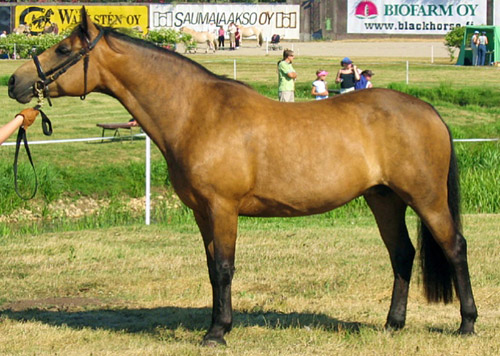
Buckskin coloring comes from the addition of a creme dilution gene on a bay and even a single dilution of a creme gene can produce blue eyes.
They are also a rare color because they are reliant on the creme gene which is elusive and can be difficult to reproduce, even if both parents carry it.
You can read more about buckskin horse genetics on Horse Info and ehow advice.
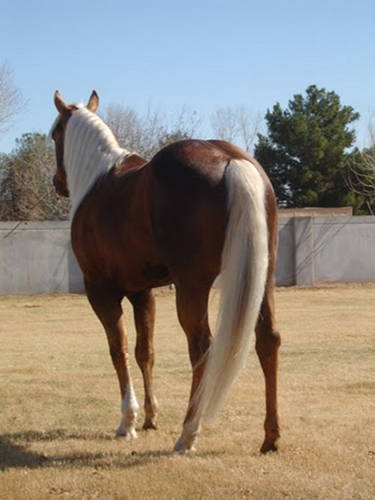
A chocolate palomino is usually the result of a paring between a palomino and a liver chestnut animal and is actually considered a palomino because it is created by the creme dilution gene.
You can read more about palomino color genetics at Horse Genetics
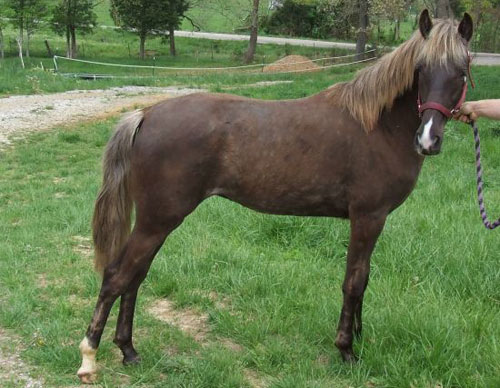
The silver dapple color is a result of a silver dilution gene on a black base and it is indeed a rare color. Gaited and mountain breeders call it chocolate and Icelandic breeders call it blue silver.
You can find more information about the genetics of silver dapple (and other silver colors) at Equine Color.
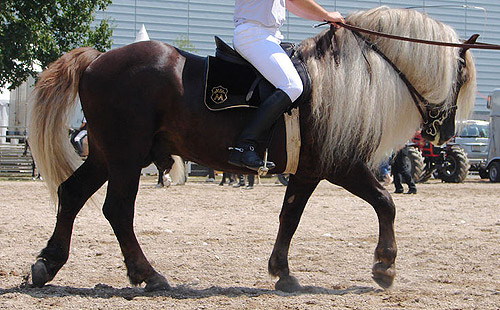
A flaxen chestnut is a horse with a chestnut base affected by a flaxen color modifier which turns the mane and tail flaxen in color. This color modifier only affects chestnut animals & is still a mystery gene that is believed to be recessive (needs both parents to carry it for it to be displayed in offspring). This modifier is commonly found in Haflinger horses
Unfortunately there is limited information to link to here, the flaxen modifier is touched upon but not much is known about it.
Disagree?
That’s what the comments are for. If you can prove my research wrong, by all means show me so I can amend my information.
Decent, but I know that you can find better info than that!
Hi Kate,
It is unfortunate that there isn’t better information about horses in general on the web. Part of my goal with this website is to bring horses online for the masses.
Because of this I depend on readers like you who respond, give me feedback and tell me what you want and don’t want to see.
I’m ecstatic when I find new sources of information, and if you have any to offer, please let me know.
Hey, I like this site. Thanks for sharing your knowledge of horses. I’d like to see how horses jump. I’ve always been interested in it. Thanks a ton! Isabelle
What about the picture of the pink horse is that natural colored or was it died that color?
Hi Meghan,
That image was taken by Jesslee Cuizon in Baguio City, Philippines and that’s no natural pink horse, it was definitely dyed that way. 😉
You might want to include zebra dun and grulla in your list. Grulla or grullo is very rare. You can see pictures at http://pets.webshots.com/album/54549602tliHsr
@ DianneC;; ‘Grulla/o’ is not as rare as one might think. The thing making it a rare color among horses is the fact that it is so easily mistaken for a variation on the dun gene/factor. Grullo/a is similar to the dun to the point that it actually does take a genetics test on your horse to determine whether it is or it isn’t. Grullo/a is common in mustangs, quarter horses, and other breeds that have a high quantity of ‘dun’ in them. This includes the ferral prezwalski as well. Albeit in prezwalski’s anything variant from their typical dunskin color is considered rare, and hard to breed for, Grulla/o will be found in their genetics. 🙂
@ kayla;; Brindle is such a rare and little-known genetic in horses period that any color variation is considered rare.
I saw the name Corn Planter horse mentioned in a book named Roseanna of the Amish by Joseph W Yoder (p. 177) as if it were a breed of horse. I am unable to find any info.
Thanks Doris,
I’ll do some research into them. If you come up with anything be sure to let me know!
Hi,
I am in no way trying to be rude, but there are a few corrections you might want to make about the “rare” color you have listed…
1) There are NO albino horses. What you are thinking is albino is actuallu Lethal White. This happens when you breed homogenous frame overoXhomogeneous frame overo. The comnbination produces a white foal that will die within 72 hours due to a unformed colon.
2) There are white horses but there is no “white gene” white horses are actually pintos with a maximally expressed sabino pattern. There is no proof that this crossed with itself will produce a lethal white because there have never been any born which leads people to believe that it is a incomplete gene.
3) Black horses are not rare. They are one of two actual “colors” that horses are born with (the other being chestnut). Other colors are actually black and chestnut horses with another gene that modifies these colors.
4) Buckskin are not rare. While cremeXcreme horses have blue eyes, buckins do not. The only way a bucksin could have blue eyes and be a solid color is if it caries the homogeneous frame overo or homgeneous splash overo gene. (This also explains solid Quarter Horses with blue eyes)
*also if you breen two horses each with one creme modifier (say palominoXpalomino) You will have a 50% chance of a cremollo making it not very rare*
5) Palomino horses are not rare.
6) The flaxen modifier is also quite common. Although not much is known about how it affects color and why.
If you want to look at rare colors look at the champagne modifier which is new and not yet understood. It is a dominant dilution gene that affects red color to become golden and black to look taupe/brown. The horses are born with pink skin that later turns purple with mottling and blue eyes that later change to amber. These colors have often been mistaken for palominos, bucksin, and smokey blacks (which may be why the author has mentioned bucksins with blue eyes).
Like I said, I am in no way trying to be rude… I’m just trying my hardest to put correct information out there. 🙂
bravo! well said.
Another rare gene out there would be brindling. i’ve read up on that and there seems to be very little actually known about the source/cause of brindling on horses. It’d be interesting to see what all could be gathered into one spot.
sorry to say to everyone that think there arnt albino horses but aa true fact i breed them and i have discovered that putting two of them together dose make another one, and they r not like mules that you can’t breed because they turn out all males.
1. Cremello is generally said to be a rare coat colour because very few survive birth to live into adulthood.
2. There is a white gene, in general. It is called the W gene, quite obviously.
http://www.jenniferhoffman.net/horse/equinegenetics.html
http://www.horse-genetics.com/cremello-horses.html
3. Real ‘rare’ coat colours (please not this is in my opinion)
-Cremello
-Perlino
-Brindle
-Dominant White http://www.horse-genetics.com/dominant-white.html
-Smokey Cream
4. Lethal White Overo; look into it.
Despite my horse being Perlino/Grey and having a rare and fatal form of cancer I think it is nonsense to suggest that most Cremellos die as foals. Cremello is becoming a very sought after colour in the UK because it’s a sure fire way of getting a palomino from a Chestnut horse. A Cremello mare is worth more than double of a horse without Cream and substantially more than a single dilute mare. You can go one websites for Welsh breeders in the UK and find Welsh Cob Cremellos happily breeding into their 20’s. I think you must be mixing it up with something else or just misinformed. I thought double dilutes and champagnes were huge in the US?
Nikki,
I would just like to say that Lethal White is NOT incurable. You just need to know the symptoms and you need to call the vet if your paint foal is white and hasn’t passed a bowl movement in the first four hours. If caught soon enough, a surgery can be performed to remove the blockage in the bowls.
Actually,a true black is VERY rare. There are very easily lots of “blacks” all over the world, but not a true black. They could be a brownish black, or a bayish black.
If you breed palomino to palomino it’s 50% chance of palomino, 25% chance cremello and 25% chestnut.
Not like you stated above
Janet
Actusly a BLACK PALIMINO, which was clearly stated, is in fact a very rare horse indeed.
ummm… yya acutaly there are albino horses. When something is albino its when there is no pigment in the skin hair,exc and it can happen to any animal. There for there are albion horses. 🙂
B,
Actually, there are no albino horses. When you’re a geneticist, you can tell us how you finally found the gene which is not there; until then, I do hope that no one trusts your information as reliable, particularly as you lack any information to support your statement, as well as a license or research to make that statement valid in any way, and on a much smaller scale, because your spelling is atrocious.
There may well be albion horses, although I’ve never heard of them, but there are no albino horses in living existence. Sorry, but simply because a creature lacks pigment in it’s skin does not an albino make. True white horses have pink skin and brown eyes. I believe albinos generally have pink or red eyes, and I’ve yet to hear of much less see a horse with this trait.
Just pointing that out, in case you didn’t actually read the article.
I have seen a horse _displaying_ what looked to be albinism but the owners tested it and found out that it was a cremello or something like that. I don’t remember what they said it was at the time, it was years ago. The horse, honestly, looked like a genuine albino, pink around the eyes with almost a pink colored eye itself, which would be why people seem to think albinism exists among horses.
Saying horses are albino is like calling a polar bear an albino black bear or something. It’s false information made based on the general appearance of an animal.
But I do have a question, wouldn’t albinism be considered the lethal white gene among horses? As far as I have seen lethal white foals (I understand the requirements on the parts of the parents to create a L.W.) are pale skinned, white, and have lighter colored eyes. Or would that be just from the way things were shown that I’m seeing this?
No such thing as Albinism in horses.
My mare is sorrel. Isn’t that a rare color?
no
No. Sorrel is a type of chestnut, which is the most often occuring color other than bay.
Hello Paige,
Four different “W” or “Dominant White,” mutations have been identified in the KIT gene that cause phenotypical variation of 50% to 100% depigmentation, regardless of base colors identified for the various inviduals studied. “W” is not part of the sabino complex according to the geneticists who are researching these genes (e.g., Dr. Samantha Brooks, UofK).
Two of the W mutations are missense mutations and two are nonsense mutations. Dominant white horses can be born with pigmentation running along their ventral portions which usually depigments over the first years of the horse’s life.
Dominant white horses have pink skin and dark eyes. One individual identified as Ww does have a blue eye, which is hypothesized to come from other color genes co-existing in his genotype (e.g., splash), not W.
To date, all dominant white horses that have been identified are heterozygous for W. It is believed that WW is an embryonic lethal, given the location on the KIT gene of the W mutations. You therefore cannot have a WW “albino” born from breeding Ww horses.
For additional information on dominant white, consult the peer-reviewed article, “Allelic Heterogeneity at the Equine KIT Locus in Dominant White (W) Horses” by Haase, Brooks, et al, published in November of 2007 in PlOS Genetics.
Some other points regarding your other color information listed above:
1. A perlino is genetically an E_A_CC (bay with double cream), not a “chestnut base affected by a double dose of the creme dilution gene.” A cremello is the chestnut base with CC. You’ve missed smoky cream, btw, which is a black base, no agouti, with a double cream dilution – EEaaCC. 🙂
2. Palominos are not considered “rare” by geneticists or by breeders in many breeds which commonly have the cream gene (e.g., quarterhorses). Palomino coloration is easy to breed for as long as you understand the genetics underlying your breeding choices, and the genotypes of the individuals you are breeding. Genetic testing for the cream gene is widely available, and relatively cheap.
3. Buckskins are not considered rare either – for the same reasons as #2 above. Also, buckskins do not have “blue” eyes per se, the way double cream dilutes do. Many single cream dilute foals (e.g., buckskin, palomino) do have blue or blueish eyes at birth, but the eyes usually darken to an ordinary brown as the foals age, in most cases.
4. There is no genetically substantiated basis for stating that a “chocolate” palomino comes from a liver chestnut and a palomino. You could breed a buckskin (EeAaCc) to an ordinary chestnut (eeaacc) and get a chocolate palomino (eeaaCc). The term “chocolate” (in breeds other than TW and RMH, where it refers within their registries to horses that are genetically silver dapples – Zz or ZZ) is simply a descriptive term for the phenotypical expression of factors we don’t yet understand that darken the coat of the individual palomino, factors such as shade and sooty and more.
5. Flaxen is quite common in many breeds, including Morgans, and Belgians, for example.
JAS,
You are amazing! Thank you very much for your information, I will go through and update these areas so I have included your expertise. 🙂
Paige, I’m glad you find it helpful!
I have a typing error in the above that’s important – oopsie, that’s what I get for leaving a comment at 1:30 in the morning! 😉
Where it says, “Dominant white horses can be born with pigmentation running along their ventral portions which usually depigments over the first years of the horse’s life,” it should say DORSAL instead of VENTRAL.
Brain said dorsal… but that’s not what came out. 😀
Hi Heather,
Sorrel is chestnut. Chestnut and black are the two base colors that create all other horse colors.
There are many different shades of chestnut, some more common than others, but I believe most of them are fairly common (pretty though).
Hi I have a Two year old Quarter horse filly. Her dire is grey and her dam is a Palomino. When I got her at eight months she was a palomino and now that she is turning two she is beginning to turn grey. I don’t know what color she will be. Do you have any idea what she might turn out to be?
Thanks Maggie Murray
She will be grey. Grey is a dominant gene to the point of any parent being grey means that baby will be grey as well. Fun to watch them turn though. 🙂
I was just wondering, was the pink horse dyed??
I have a spotted saddle horse mare that I bred to a tobiano SH stud. The foal turned out to be pure white with pink skin and dark blue eyes. I believe from what I have researched that he is a dominant white. Would you agree and how rare is this.
It sounds like you have a Cremello. Without a picture its hard to say.
hi, i’m writing a speech for my English GCSE about horse riding and horses. The tallest horse in the world, called Radar is a chestnut-sorrel with flaxen mane and tale. I have no idea what this colour is apart from chestnut. Could you help me please? I have to do my speech on Wednesday 20th May, thanks.
Albino horses do exsist. Tonight we called our vet out and had him examine our 2 month old colt. We he arrived I asked him white or Cremello? He said white and actually Albino. I said I have read and heard they do not exsist. He said they do exsist they are just very rare.
Albino does NOT exsit in horses. If it has Blue eyes its Cremello or Perlino. Albino animals have pink eyes.
I have a family member that cares for horses that are old and would have been put down by their owners do to no longer being useful to them. She has had 3 white horses in the past 40 years with pale pink skin and redish pink eyes, her vet has informed her that they are indeed albino (Albino:is a congenital disorder characterized by the complete or partial absence of pigment in the skin, hair and eyes due to absence or defect of an enzyme involved in the production of melanin and is known to affect all vertebrates, including humans). He also thought that out of the dozens of all white horses with pale pink skin but normal eyes, that some of them (but not many) might have Leucism (this differs from albinism in that the melanin is, at least, partially absent but the eyes retain their usual color. Some leucistic animals are white or pale because of chromatophore (pigment cell) defects, and do not lack melanin). They were all lovely horses ^_^
This is a reply to yours becky
Chestnut sorrel is just a darker shade of chestnut, and the flaxen mane and tail bit just means he has a blonde/White flaxen, mane and tail!
Sorry it’s not in time for your essay though 🙁
Hope it helps?
Hello this is very interesting and I am glad you put this up. There is one coat color that very little people know about, but the Friesian can be one other color. Chestnut. IT is a very rare color and can only occur if both parents contain the Homagazyous(or however it’s spelt) Gene and then they have like a 15% chance of producing a Chestnut foal. The rule though is that that foal can be regestered as a Freisian, but the offspring of that foal cannot be regestered as a Friesian (And yes this is with PUREBRED Friesians.
Just though you and others would be interested in that.
Hi Becca,
Thanks for the info. Feels wrong to think of chestnut as a rare color, but within a breed known for their shiny black coat it makes perfect sense. I’d love to see a pic if you have one.
It seems there are a lot of rare colors that I haven’t listed here…hmmm I feel another post brewing. 🙂
Hi Gina
Horses does not carry the albino gene, there is only Lethal White Foals and they normally die short after birth, you only get cremello and perlino horses for they both have black pigment on there skins somewere on there bodies and there eyes (especially the cremello’s) have blue eyes with 2 different blue shades and freckels. As known in other animals and humans, albino’s does not have any pigment, but the cremello and perlino always have pigment somewere on there bodies. There is NO albino’s in horses, that vet surely does not know his genetics in horses so then he should not inform clients about genetics if he does not know the facts for sure. I breed cremello, perlino, palomino, buckskin/dunn and pinto horses for years now and I never ever came across a albino.
Just helping out on the info…
Regards,
Rosie
Hi Rosie,
Thanks for the information. From what I understand you are absolutely correct. And it is usually cremello or perlino horses that are mistaken for albino animals.
Love to see some images of your animals…;)
This sucks!Are you kidding me, this is a useless piece of s*** how dare you even dare try to write about horses are you mental? This sooooooooooo wrong!
i dont understand any of this!!!!! i had a pure white filly with pink pigmants 2 weeks ago! she has no dark pigments on her. she is still alive and healthy! she has dark eyes with pink pigmant surrounding them! so that does not make her an albino, but a pure white horse!
hello i dont know if you question about your filly has been answerd yet or not. i hope it has by this time but if not it will be now lol to me she sounds like a maximum sabino i have three here on my ranch. they can be seen on my website http://www.lonehorseranch.com this color can occur in all breeds including Quarter horses and thurobreeds. as she groes you may find dark spots on her skin and you may not but she will need sun protection her intire life or she will have a high chance of geting skin cancer.
hope this hellps
thx
cynthia
Hi Joanne,
If the filly has dark eyes then she can’t be albino. Albino animals have no pigment whatsoever. Do you know anything about the bloodlines of her parents?
Unfortunately I don’t know enough about it to be able to answer your question, but hopefully one of my readers will. 🙂
You have to remove the “albino” word from horse talk. Albinos in humans and some other animals can happen, but in true definition Albino = lethal white, they have no pigment and are therefore usually blind because the eyes lack any pigment also. Blue is a pigment, so a horse with blue eyes is not an albino. My father was raised on a horse ranch his whole life and he said ranchers used to destroy true white or lethal white horses because they rarely lived and were blind. If a horse has even one dark spot in the eye, skin or hooves, they cannot be albino! always areas surrounding genitals, inside of mouth, ears, etc. for color. If spots or dapples found, then not albino or lethal white.
You should not be so rude! I have an old issue of an Arabian Magazine and on the front cover is a strawberry roan that from distant pictures looks pink! Yes, up close it obviously is a roan, if you know what you’re are looking at. But it still looks pink! Have you seen pictures of the pig with lime green snout and feet! It is real, but has been gentically modified. If you had enough money nowadays you could probably own a pink horse! It is possible. Gene splicing technology!
I too have see a ” pink” horse…it was a purbread Arabian that was classified as rose grey..but from a distance definitely looked pink. MSU Secret Vow is her name.
Hi Paige
I have added info on Albino in horses with quotes and website addresses for reference.
I do not know why anonymous is so cruel and rude, does the person not know how to communicate properly with other human beings, just wondering how this person will work with animals if he/she is so rude towards humans? Normally people like this is more rude towards there animals… shame.
Anyway, herewith the info I had promised with references: IT IS ALL EXPLENATORY, NO ALBINO’S IN HORSES, LETHAL WHITES AND THEY DIE SHORTLY AFTER BIRTH = FACT
http://www.angelfire.com/wy/4thorses/albino.html
Think you’ve seen an albino horse? Read this.
Is it a Cremello, or is it an Albino?
by Lana Sibley
I told my friend that there are no albinos in horses
and he looked at me like I was nuts. “I have
seen them!” he said. I tried to explain that what he
saw was probably a “cremello” and not an
“albino”. He just shrugged. His basic stand was this:
I was calling it one thing and he was calling
it another, but it was still the same horse, and in
his book… an albino.
So my point here is to explain why albino and cremello
are not the same thing. I’ll make this
brief without any genetic letter combinations to
confuse and confound. I just want to explain
what an albino actually is, and how it comes to exist.
And then I’ll point out the differences
between it and a cremello horse.
There are several different genes that cause albinism
in the species in which it exists. We say it
does not exist in horses because genetists have never
found a horse that meets the criteria to be
considered an albino, not because it is impossible in
one species while possible in another. In my
understanding, even the genetists don’t know why it
doesn’t exist in horses. Its existence has just
never been proven.
Albinism is created when an offspring receives two
recessive genes from its parents… one from
each parent. The parents do not exhibit any signs of
albinism… a recessive gene is completely
masked or “overpowered” by the dominant gene in the
pair. So the parent carries the gene
without being albino. The different types of albinism
all affect pigmentation, and also carry with
them some other genetic problems including eye
problems, blood clotting problems, and hearing
problems.
But the creme gene, which causes a cremello, is not a
recessive gene. It is what is referred to as
an “incomplete dominant” gene. This means that it
shows even when there is only one copy in
the gene pair (because it is dominant) but shows more
strongly when the horse carries two
copies! A horse that carries one creme gene is a very
popular animal in today’s horse world! He
is usually either palomino or buckskin. The single
creme gene dilutes the chestnut or sorrel
basecoat to a gold or cream color and the mane and
tail to white. But it does not affect black
pigment, so on a bay basecoat, it creates the same
golden color, but leaves the mane, tail and
points black. There are also horses who have no red
hair on their bodies and the gene can be
hidden there… these are called smoky blacks. Only on
true blacks is the gene totally masked,
because any brown or red hair will be turned to gold
and give those horses a “glow”.
When the horse receives a copy of the creme gene from
each parent, you have a cremello (on a
chestnut basecoat) perlino (on a bay basecoat) or
smoky creme (on a black basecoat). But, just as
it is not a recessive gene like the albino gene, it
also does not carry the associated genetic
defects. There is no indication that cremellos,
perlinos or smoky blacks have the eye problems,
blood clotting problems, or hearing problems that come
with an albino gene. This is because the
creme gene is a totally different type of gene.
Albino is one thing, caused by one genetic factor.
Cremello is another, caused by a completely
different genetic factor. So you see that it’s not
just an argument over what we call them!
Want to learn more about the creme gene that causes these beautiful colors? Click here to visit the Cremello Perlino Education Association, A Very nice site that should be able to answer all your questions.
*************************************************
Other references quoted:
http://en.wikipedia.org/wiki/White_(horse)
Horses do not have non-melanin pigments and so if they were albino, would have no pigmentation. The retained pigment of dilute horses, like cremellos, is not comparable to the retained pigment of amelanistic “albino” birds and reptiles. Despite this, some registries still refer to “albino” horses. For example, the Paso Fino Horse Association registers cremellos and other homozygous creams as “albino.”[21] Until 1999, the American Quarter Horse Association (AQHA) described cremellos as “albino” in rule 227(j).[22] The AQHA later replaced the word “albino” with “cremello or perlino,” and in 2002 the rule was removed entirely. Among Connemara pony breeders, homozygous creams are alled “blue-eyed creams” or sometimes “pseudo-albino” and remain barred from the stud book.[23] There are also references in literature to “albino” horses.[24] The cream gene, which is responsible for palomino, buckskin, and cremello coat colors, was mapped to the MATP gene in 2003.[25] This gene is sometimes called the OCA4 gene, because one mutation on MATP is associated with oculocutaneous albinism type 4. However, other benign mutations on MATP are responsible for normal variations in skin, hair, and eye color in humans.[26] MATP is not the “albino gene”; one of many mutations of the human MATP is responsible for a form of albinism.
[hide]
v • d • e
Equine coat colors
Base coat colors
Bay • Black • Chestnut (also known as Sorrel) • Gray •
Dilution modifiers Dilution gene • Dun • Grullo (variation of Dun) • Silver dapple • Champagne • Pearl dilution • Lavender foal syndrome (also called coat color dilution lethal) • Cream gene (influences) • Buckskin • Palomino • Cremello • Perlino • Smoky black • Smoky cream • Isabelline
Other color modifiers Sooty • Liver • Seal brown (horse) • White (includes genetically distinct): • Dominant white • Sabino-white • Lethal white syndrome
Markings and patterns Horse markings • Primitive markings • Bend-Or spots • Cropout • Point (coat color) • Pangaré • Brindle • Leopard complex (see also Appaloosa breed, Knabstrup, and Varnish roan • Roan • Rabicano • Pinto horse: (Patterns include ) • Overo (including genetically distinct Splashed white, Frame, and Sabino) • Tobiano • Tovero • (Color variations): Piebald • Skewbald • Tricoloured]
Genetics and breeding Equine coat color genetics • color breed • Wildtype
&
Albinism in animals
http://www.bio-medicine.org/biology-definition/Albinism/#Albinism_in_animals
Albinism is not restricted to the human species—other animals also carry these genes. Albinism tends to be more hazardous in the animal kingdom, where vision and pigmentation are usually strongly linked to survival. However, albino animals are often kept as pets, e.g. albino gerbils.
There have been no reports of true albinism in horses. White horses lack the pink eyes that make a true albino.
&
http://www.geocities.com/colorgallery/genetics.html
Two cream genes result in a white or cream colored horse with pink skin and blue eyes. These are not albinos, there has never been a documented case of albinism in horses. Neither are they lethal white horses, which are homozygous for the frame overo gene and always die soon after birth. Two cream genes do succeed in diluting black hair, but still less so than red, so that double dilute bays, or perlinos, often have noticeable points
&
Albinism
http://www.reference.com/browse/wiki/White_(horse)
True albino animals have a white coat, mane, and tail, with pink skin and pink eyes. However, there is no reported case of a true albino horse. Albinism in horses appears to be linked to lethal traits and albino foals do not survive. Therefore, all living “albino” horses actually have blue or brown eyes and thus are white horses, not true albinos.
In horses, the white or “W” gene is known to be responsible for the absence of pigment which is usually referred to as albinism. The theory that “dominant white” is lethal in horses–when the W gene is homozygous (WW)–was first proposed as a theory in 1953 and after 15 years of test breeding, was confirmed in 1969. The same group of researchers found that the WW gene complex was also lethal in Dexter cattle, platinum foxes, and bluefrost minks.
The American Albino Registry was originally formed to register white and cream-colored horses. However, living white horses are never true albinos, so as the genetics of dominant white and lethal white became better understood, the registry renamed itself the American White Horse and American Creme Horse Registry.
Hope this helps clearing thins up!
Have a good day,
Regards,
Rosie
Hi! I work at a horse rescue and one of the horses is a solid chestnut- no white markings anywhere. Would you consider this a “rare” horse color or not? I tried looking up the information online, but I can’t find a thing. Thank you!
Hi Julie,
Chestnut is one of the two base coat colors. And although an animal without any white markings is unusual, I don’t know if you could really call it rare.
Which rescue do you work with?
HorseNet Horse Rescue. The horse’s name is Red, he has a movie: http://www.youtube.com/watch?v=f8t5qPlcbZQ
Speaking of which… Can you go to the rescue’s website and tell me what color you think Comanchee is? (bottom of the page). Someone told me his color was uncommon, but I can’t remember what kind they said. Thanks so much! http://www.horsenethorserescue.org/adopt.htm
Hi Julie,
It’s a small picture so it’s hard to tell, but his coat looks shiny, almost like he has a champagne gene.
Do you have a larger image of him? I’d be glad to post it and see if any of my readers can help. 🙂
Hi! Yes here’s a larger picture and a better one too. http://i159.photobucket.com/albums/t124/jp2juli/horsenet229.jpg
Actually not to be rude but correction the tallest horse in the world was sampson standing at 21 1/2 hands high. He was born before cameras were even made and has not yet been out grown 🙂
The horse in your picture is a red dun. He does not have a champagne gene. If he did, he’d have a shiny metallic look like the stud in the following URL.
http://www.triplegaitranch.com/images/cotton2005.jpg
Apologies, I replied to the wrong post. The champagne horse is in reference to Julie, not Jessa.
Flipper
I have a cremello Welsh mare. If I breed her to a black stallion what will I get..? I chestnut stally? I have heard that if you breed a cremello mare to a certain color stally, you will get a silver dapple. What color of stally is that?
THanks
Cremello genes only carry dilute colors. So your mare will only produce cremello, smokey black or perlino. Pure cremello’s do not carry other genes.
Hi people, am wondering if anyone has lots of color information on appalossa colors or a color wheel for breeding purposes ??
i have a 10 yr old snowflake appaloosa. shes charchol/black with small white dos all over her body. i know she is rare the are no pictures any where (except two) of another horse like her
Conie,
One of my favorite breeds! There is SOOOO much info on appaloosa color and genetics, so you might want to go online and do some research. It would just be too much to type out on here! But maybe if you have some specific questions I could answer here.
Um.. sorrels are NOT rare it is the wetern word for “Chestnut” are chestnuts are NOT rare!
I’d just like to correct some other individual’s comments as I’m an Equine science major….Here’s what “Nikki” said:
1) There are NO albino horses. What you are thinking is albino is actuallu Lethal White. This happens when you breed homogenous frame overoXhomogeneous frame overo. The comnbination produces a white foal that will die within 72 hours due to a unformed colon.
2) There are white horses but there is no “white gene” white horses are actually pintos with a maximally expressed sabino pattern. There is no proof that this crossed with itself will produce a lethal white because there have never been any born which leads people to believe that it is a incomplete gene.
—————————————————–
*1) It’s true, there are no albino horses alive because having two white genes is lethal. However, this person is thinking of Overo Lethal White Syndrome, which actually has nothing to do with truly white horses.
*2)There is a white gene, commonly noted as a capital W. A truly white horse will have W on one loci and w on another. When two truly white horses are crossed there is always a 25% that the foal will end up WW, which is the lethal “albino” situation. There is also a 25% chance they won’t have a white foal at all, in which case it would be ww.
UC Davis’ vet school website has a really cool genetics page for color prediction in foals and genetic information on horse coat colors.
I have read all what is written about “albino” horses on this page. I would like to add that we had a white horse with pink eyes and it was a mongrel of a thing. I doubt if it could see at all.
Eddie, did your horse have ANY darker markings on its body? If it did, it’s not an Albino. How old was it when it died or did it die shortly after birth.
Did your white horse with red eyes die shortly after birth? What color were the parents?
The white horse with pink eyes was around 4 of years old when we purchased it. Do not know the history.
I had a 28 year old gelding who died recently of skin cancer. He was white, pink hooves, pink nose, and pink around the eyes. His skin was pink too. (He got tons of sunburns and he stayed in a shady pasture to keep him from skin cancer, but he finally succumbed to it.) Here’s the weird part. He had one blue eye, and one brown eye. What did that make him? lol
Probably a maximum paint of some variety. This extreme “chrome” effect is seen most often with the sabino pattern, I believe. I say this because you said he had one blue eye. If both were brown, he’d be consistent with the requirements of a white genotype.
Amber, your horse probably had a lack of melanin. I’m no expert so I’m not really sure.
Actually LWO can have SOME color, but its so limited most won’t even notice it. (like by the ears or tail)
No. Sorry. Sorrel is one of the most common colors. The two base colors for horses are Black and Sorrel. All other colors are produced by a modifying gene on top of those colors.
She will be grey.
Sounds more like a maximally expressed pinto pattern. I believe DW has only been seen in TB? Or at least those are the only horses I have seen it in.
I would:
A) Get a second opinion because it has never been reported.
B) Get a DNA test on the horse and contact UC Davis.
C) Call you local news station.
Sounds like a maximally expressed sabino to me… Think of it as one big white spot on a colored horse.
To a black stallion – you could get black, smokey back, chestnut ,palomino, bay (if she carried the agouti gene), or buckskin (if she carries agouti)
To a chestnut stallion – chestnut or palomino
The only way to get silver offspring is if she carries it (you cannot see it on chestnut based horses, so you would need DNA testing) or if you breed her to a stud that carries it… but theres still no guarantee unless one of them is homogeneous.
I am aware at this point of the W gene. I don’t really deal with thoroughbred, and even then the DW was still up for debate.
But there are still no albino horses. Not because have two copies of the Albino gene is lethal, but because the albino gene has never been found. W/W does not make a horse albino. W/W is similar to LWO.
Do you have pictures of it? If not, that is a great loss to the equine community.
I have a strong feeling Eddie is just trolling, or thinks pink skin around the eye means a pink eye.
Amber many horses have one blue and one brown, it is common in paint horses. It is a sign of the splash white gene. Most horses who get skin cancer are grays unlike people, the cancer is caused by the gray gene messing with the pigment not by sunlight. But it of course possible for any horse to get cancer.
I have a Perlino Grey who is only just two years old and she has been diagnosed with malignant melanoma. I can’t get any information other than she will die of it and also that the lightness of her coat makes her tumours more malignant…not the grey presumably but the cream. It was fairly hot (for the time of year) a few weeks ago and tumours popped up all over, it’s gone cooler and there have been no new ones. I am in limbo over what to do and where to go for any more information but the top UK specialist has seen her slides and he gave me no more new information other than ‘fatal’, no timescale nothing. If any people have knowledge of any other young horses with malignant melanoma please can they get back to me Lindylou@gofast.co.uk
I stumbled upon your site & I’m very interested in the albino topic. How do you explain the American Albino breed started by Cal & Ruth Thompson of the White Horse Ranch in Naper Nebraska? I assume you are familiar with it. These horses are white with pink skin & blue or brown eyes. It’s sad that the ranch has been closed & the horses have been dispersed & sold. I don’t know if someone is continuing the breed.
My aunt had one of their horses many years ago, these horses are very dear to us.
Bob,
You asked about albinos and stated shortly thereafter that the people breeding them had horses bearing blue or brown eyes. Albinos lack pigmentation of any kind in any part of their body.
If your horse is white, it’ll have brown eyes. If it’s white and a paint, it might have blue eyes. If it’s “white” due to dilution genes, you’ll be able to find the actual white markings on it if you look close enough, it’ll have blue eyes, and if bred to a chestnut or black horse, the foal will be colored every time.
Good curiosity!
Hi just to let you know the albino has pink eyes not blue eyes. Also there is no such thing as a chocolate palomino, what you are calling a chocolate palomino is a silver taffy.
Daina,
“This dilution gene, “Z”, is most widely called “silver”, although in Australia it may be called “taffy”. Silver, or “silver dapple”, is the most widely accepted term. In the Rocky Mountain Horse breed, it is often called “Chocolate” or “Chocolate Flax”.”
-http://www.ultimatehorsesite.com/colors/silver.html
-http://www.horse-genetics.com/silver-dapple.html
Chocolate palomino is the term more commonly used in the quarter horse or stock type paint world.
-http://www.doubledilute.com/palomino.htm
Flipper
I thought a chocolate palomino was a palomino with dark smutty uniform hair over the body to make it darker. I’m quite sure they exist. I’ll admit I’m not sure if the picture on this site is, because I can’t genetically test the horse, but palomino’s can be dark.
What is your palomina out of
Mmk, here we go:
Brindle horses do not have to display a dorsal stripe. Actually, any dorsal stripe is caused by the dun gene (and that is on any color of horses). They (as well as all colors of horses) may have counter-shading, which can be mistaken for dun, but is not, and is rather just a distrubution of darker hairs.
(http://www.brindlehorses.com/l3l13/characteristics/brindun.htm)
Buckskin horses do not have blue eyes, unless another gene (usually a pinto pattern—splash or sabino) is interacting. Same with palomino horses and their eyes. Only double dilutes (cremello, perlino, smokey creme) will have blue eyes without the interference of any other gene(s).
Silver dapple is not an actual color. Silver is a modifier that will modify a black based coat. Most “silver dapples” are actually black silvers/silver blacks.
(http://www.silverequine.com/silvercolor.htm)
Also, “black socks” from the leg markings post are just black points, which will occur on any E? horse.
The “random marking” and stockings you posted are also likely caused by the sabino complex.
Hey, I read a bit on here, I am totally a genetics finatic.
The only thing though is that a Perlino and a Cremello are not both based off of the Chestnut Coat.
Cremello is 2 creme genes on a Chestnut coat
Perlino is 2 creme genes on a Bay coat
Smokey Cream is 2 cream genes on a black coat.
Just thought I’d mention that. 🙂
An excellent blog http://www.equinegenetics.blogspot.com/
Yes the pink horse was dyed that color.
Maybe you can answer this.
I was always curious what my horse’s color was exactly. I acquired him in 1987 when he was 7. (He passed away last year.) He was gelded when I got him. At first I thought he was white, but shortly after getting him I realized that was certainly not the case. He had yellow eyes, pink skin, and if you looked closely enough you could see that he had actually had a white blaze. In essence, he was the lightest color of cream I have ever seen.
He came with no paperwork, but I swear he was a definitely a Quarter horse. I always felt he was a palomino gone wrong and a big disappointment to someone(not me). Best horse that I EVER had. He lived a long and happy life.
Was he a double dilution? Was the breeder not allowed to register him as a Quarter horse because of this?
Maureen,
Your horse was most definitely a double dilute. My suspicion is that he was diluted by two separate genes; possibly having three or four dilution genes in total. The extreme cream can be explained by his homozygous dominant inheritance of the cream dilution gene while the yellow eyes make me think he probably had at least one champagne gene shining through, literally.
http://www.chboa.com/research/champagneshades.html
http://www.doubledilute.com/palomino.htm
There has been a whole race of horses – the Herrenhaeuser Whiteborns with the Ww combination. They were called Atlas-Schimmel.
Palominos are awesome!!!!
I completely agree!!! (Though I think that all horses are awesome no matter what the colour)
Although I’m nowhere near an expert on horses or genetics I just thought I’d remind you all that one of the most important diagnostic symptoms of albinism in horses (or any mammal for that matter), isn’t so much the skin color but the condition of the eyes. I don’t really know enough about it to say there aren’t true albinos in the horse world-I’ll just take everyone’s word for it- but I do know there are several abnormalities seen in the eyes of albino animals (and people)that are a clear indication of a true albino. Just throwing that out there.
Paige-
This is actually wrong. There are slight differences between sorrel and chestnut. Chestnut has more of a brown tint, while a sorrel is more of a red color. Thought you would want to know.
The difference between sorrel and chestnut is different for so many people that I don’t think you can say the other is wrong
Friesians can only be BLACK. Figure it out
Kate,
Next time you make a statement, please research it first; sorrel or chestnut Friesians are referred to as “Fox” Friesians. Friesians, as a breed are not fixed at homozygous dominant for the Extension locus. Heterozygotes are red carriers; see the genetic calculation below. If Punnett squares aren’t something you like to use, find a color calculator: http://www.animalgenetics.us/CCalculator1.asp
(Black Sire) Ee x (Black Dam) Ee
Foal possibilities: EE (Black) 25%
Ee (Black) 50%
ee (Red) 25%
Sorrel Friesians:
http://www.ultimatehorsesite.com/colors/chestnut.html
http://www.angelfire.com/tx2/friesians/red.html
http://friesian-crazy.tripod.com/health.html
Hello!
I’m very interested in horses and genetics. I’m glad to share my knowledge with you.
I’m happy you found a lot of information that is true, and that a lot of people emailed you back. I’ll start my discussion with white horses.
There are three kinds of white: Cremello, Gray, and Dominant white. Cremello is a chestnut base with two cream genes. They can be identified by their blue eyes and pink skin. Gray horses have dark skin and dark eyes, but can look almost white. Cremello and Gray horses are not albino or true white. True white is known as Dominant white. These horses have pink skin and dark eyes. And yes, there are no true albinos that survive. Perlino horses are bays with two cream genes, thus having pink skin and blue eyes. I’ve never heard of them being mistaken for white because you can see their points(see http://www.thehorseguide.com/images/Perlino.jpg).
Now to talk about flaxen.
It’s true- Flaxen is a mystery yet to be discovered. Let me give you a quick, understandable genetics paragraph.
Most genes are either dominant or recessive. In the case of a dominant and recessive gene, the dominant trait will be expressed. Thus, recessive traits can be carried and appear out of nowhere. Flaxen is more than simple recessive because two flaxen parents, which could only pass flaxen if it were recessive, have had non-flaxen foals. Check out http://www.horse-genetics.com/index.html for more info. It is where I got all my knowledge, and I think that it will be helpful. Look under chestnut on the left for flaxen info. Look under basic genetics if any terms confuse you. One last thing- I’d love to know your name if you’re willing to share it. -Camelle
Camelle,
Cremello & gray are not variations of white, something you have mentioned in your second sentence of discussion. Cremello horses are diluted but they still carry white markings and, when examined carefully, you can see them. Gray horses may start black, bay, or any other color and gradually fade with time. White horses are simply that, white, at every life stage. They stay the color they were when they arrived in the world.
The following links are both references to white thoroughbreds; both of which are extreme sabinos.
-http://www.norsirefarms.com/ourwhitelady.html
-http://www.agalopar.com/agt/diaadia/artmsg/msgselecc/msg0608/color/7lex5.jpg
Thanks to everyone for leaving so much helpful info here. Reader contributions are essential for discovering new and hard to find information. If anyone is interested in writing their own feature guest post about color genetics I would love to share your knowledge & am happy to provide full credit (and links) to you as the author.
Feel free to contact me directly if that interests you. 🙂
Thanks again!
The filly I had once thought of as albino has been tested and came back SB1 Sb1(homozygous for sabino) She came from One of Richard Bradshaw’s herd. He supposedly had a top of the line barrel racing horses. He had one sabino like Bella, the sabino. We bought the mother three weeks before foaling at a local auction. I fell terrible. We bought the mother for $150 and found she was pregnant AFTER we bought her. We all started bawling when we saw the white hair and pink skin. We thought she was a lethal. Her mother is a solid dapple palomino. Well, heterozygous sabino, and we called the last owner to see if the stallion was an overo. We told him the story of Bella and he just sighed. He was mad, we could tell, He wanted more out of the mare, but needed to reduce his herd.Nine days later the dude had a heart attack adn died. The father is tobiano sabino. 35 years of breeding for two whites and one he never got to see. This filly is homozygous sabino, with a buckskin base. tt, no tobiano present.and no lethal white. We emailed a genetics lab and they became interested in our story and did all the tests for free. Supposedly, there are only 5 SB1 Sb1 horses tested. Now 6 of course. She is still alive and healthy. I have pics of her on a for sale ad at kijiji’s in central Illinois, livestock. She is the only true white there. type it in and you’d see her pics.
http://www.theequinest.com/rare-horse-colors-the-facts/?replytocom=9363#respond
Taffy versus chocolate is a purely regional difference. Taffy is the common Australian name for the horse known to Mountain/Gaited breeders as Chocolate, and known to Miniature and Shetland breeders as Silver Dapple. Simply put, all three of these are different names for horses of the same color, black with a silver gene. 🙂
Sometimes very dark liver chestnut horses who look black with a flaxen gene are also called taffy/chocolate/silver dapple.
Hmm, judging by how you are saying he wasn’t purest white (because you could see his blaze) I would venture to say that yes he was a very light cremello.
And lol, i guess you could call a cremello “palomino gone wrong” because if you breed two palominos together, there is a possibility of the foal inheriting one cream gene each from its parents and being cremello.
I don’t know anything about Quarter Horses and what they allow to be registered, but if they allow palominos and buckskins to be registered but not cremellos/perlinos, then they need to catch up with the times and allow double dilutes, its quite unfair for breeders who pair together two very legitimate QHs to be unable to register their offspring.
My friend has a Chestnut Quarter Horse called Clipper. I have never seen a buckskin one, though.
I agree, Casca.
Oh man!! Some of that horses are realy strange, for example the pink one or the little ponie!!! My fave is the golden Quarter Horse or Palomino whatever it is!!!
Excuse me for mistakes im from Germany and im 13 years old so my englisch is not very good, but i hope its okay!!!
Hi=)
The following should provide with you with a good basis of equine genetics, as far as color goes. I found it super helpful, anyway.
http:http://www.twhbea.com/breed/patterns.php//www.twhbea.com/breed/colorandmarkings.php
http://www.twhbea.com/breed/dilutions.php
http://www.twhbea.com/breed/modifiers.php
http://www.twhbea.com/breed/coatcolors.php#Genetics
P.S. Ignore that it’s all from TWHBEA, it applies to all horses.
Sorry, I can’t seem to find Sarah Gee’s amazing article, “Cream of the Crop”, written for Voice magazine a few years back. I have the magazines, but it’s no longer archived online.
I <3 UC Davis! Their site is so informative, and I've been long inspired by their work, especially with HYPP.
Julie,
He looks like a chestnut or could be a red dun. Does he have a stripe down his spine?
That was very helpful for a report I’m doing on uncommon colors among horses. I have nine but my favorite is my palomino. Palominos are the best!! The prettiest!! THEY ARE AWESOME!!!!!!!!!!!!!!!!!!!
Yea, I think Palominos are awesome. Their coat is so amazing. I’m just wondering, is Palomino flaxen? I love all flaxen horses though.
Palominos are not as a rule Flaxen, though they may carry Flaxen. Palominos have naturally the lightening of the mane and tail without the Flaxen. If one of the parents is there is a chance that horse could be, but only a genetics test could tell for sure or if that Palomino had Chestnut offspring with Flaxen.
Hi! I have a liver chestnut horse with really red hair. I’ve never seen another one like her and was wondering if anybody else has?
Do you mean that the mane/tail is a different color to the coat?- well I don’t know, then, sorry! 🙂
I have seen several photos of Chestnuts of that description. I have no idea why though. There seems to be so many genes that control both coat shades that its possible that there are ones that control mane and tail shades.
At the Least your horse has a very stunning combo.
I was wondering if you could help me. My childhood “soul horse” Stormy was a deep golden color with a high sheen dapple paint. I don’t know about what is the proper terminology to actually name his color, but that describes it. His mane was black and white with the alternating black/white sections as thick as 4 inches wide /and as short as 1/2 inch along the length of his neck. His mane was extremly thick. He had been a parade horse, and my parents bought him from a girl who kept him at an airforce base stables (probably Eglin Air Force Base in Pensacola,near Ft Walton) The girl had showed him in hunter jumper. I simply rode that horse every where, often with my best friend Kathleen Laughlin. I even swam with him in Ft Walton, Beach Florida in the orange clay gully-water. I raced my friends, rode in many numerous adventures, jumping logs,the days were never long enough!! Any way, I dream of seeing a horse that closely resembles him in color. He was also a very proud stepper at a walk(but not in a gaited way), but looked more like a quarter horse. Maybe a slight morgan look to his confirmation. I feel that it would really take me back to my very fondest childhood memories to see another horse that resembles Stormy. His face had a slight arabian resemblence, but more solid,like one of my two current horses, who is a dapple gray quarter horse with an “arabianish” face.
Truly, that time in my life was so incredible, and as strange as it sounds, I am certain that seeing a horse that looked a lot like Stormy would allow my to just sit and picture everything, every time I got caught in the rain, ….welll..I think you get the picture. So, what do you know about my finding horses with such beauty, in a specific way?
Lisa,
Golden body + black mane = buckskin
Dark golden can be caused by dappling, inheritance of a lot of pigmentation genes stuck in the “on” position, the sooty gene, etc.
The paint pattern you described sounds like tobiano. There are three predominant paint patterns, overo (no white on the topline), tobiano (white over the topline), and tovero (a combination of tobiano and overo usually expressed by having only white over the topline, a “shield” of color over the chest and a spot of color over the flanks).
Can someone tell me about Buckskin, Dunskin and Dun and the differences? Thanx.
Snoo
Buckskins are bays with cream so they’re just like a yellow bay. They do not have primative markings like duns do. They may look like they have a dorsal stripe but that’s only from counter shading and they would never have any of the other primative marking such as zebra legs. A dun will always have a dorsal stipe and may have primative markings, but they don’t always have all of them. A dunskin is the mix of buckskin and dun. Since the cream in buckskin lightens, the dunskin would look like a lighter dun.
I’ve been researching the Liver Chestnut color and you state that “chocolate” palomino (there is actually no such named color) is often a pairing of a palomino and liver chestnut and this is not true at all. Liver Chestnut remains elusive to breed for and has not been shown to change the color level of other colors.
Cat,
“This dilution gene, “Z”, is most widely called “silver”, although in Australia it may be called “taffy”. Silver, or “silver dapple”, is the most widely accepted term. In the Rocky Mountain Horse breed, it is often called “Chocolate” or “Chocolate Flax”.”
-http://www.ultimatehorsesite.com/colors/silver.html
-http://www.horse-genetics.com/silver-dapple.html
Chocolate palomino is the term more commonly used in the quarter horse or stock type paint world.
-http://www.doubledilute.com/palomino.htm
Flipper
hi i have a 1mth old colt, he was born a steal grey colour but as he ages so does his colour, he is now a brown looking colour with a light/tan muzzle, he also has 2 dark blue eyes, not very noticable but they definately arent dark like usual. he has no white on his body at all but he has a white patch on his penis when it is down. is this a rare thing? he is the first solid colour out of my bl/w stallion, his full sister is a loud bl/w with one blue eye, sire is bl/w with 2 blue eyes and both his parents are bl/w, dam is a bay her parents are unknown to me. these are miniature horses. can you help me to figure out his colour??? please!
Melissa,
Foals are typically born with blue eyes and a hair color that does not reflect the color they will eventually be. The white patch on his penis is most likely his minimal expression of the paint inherited from his folks.
If I understand you correctly, the foals sire is a black/white pain whose parents are similarly colored and the foals dam is a bay. The parents are expressing only two color genes (other than their paint patterns), so your foal should grow up to be black, bay, or chestnut unless your stud is homozygous for black. If he is, the foal will either be bay or black.
Here is a color calculator for future reference:
http://www.animalgenetics.us/CCalculator3.asp
hi,
I would just like to tell you that you – not only – get a chestnut friesian but there is one white one, at the moment. His name is Nero and you can google him. He competes in dressage.
Juanita,
That is pretty awesome even if he’s not purebred. I hope they use him in a breeding program to put some color back into Friesians…or to start a new registry for them. Thanks for the info!
Dallas,
Your information on double dilutes are incorrect.
If you breed a horse that is heterozygous for cream to another horse that is heterozygous for cream you have a 50% chance of the horse having one copy of the gene,only a 25% chance of the horse having two coppies, and a 25% of the horse having no copies.
Double dilutes are cremello, perlino, and smokey cream. Smokey black is the result of one copy of the cream gene on a black horse.
You can absolutely have a black horse come out of a palomino and buckskin pairing. The resulting colors from that match could be chestnut, palomino, cremello, bay, buckskin, perlino, black, smokey black, and smokey cream. A buckskin horse is a black horse with at least one agouti gene causing it to be bay, plus a cream gene (so it may not pass on its agouti gene if it only has one). a palomino is a chestnut horse with a cream gene. Actually, you could even get a bay out of breeding a chestnut to a smokey black if the chestnut was carrying agouti because it doesn’t show up on chestnuts. There is far more to it than breeding palomino to a buckskin to yield a double dilute every time.
Maurene,
It sounds like your horse was a gold cream. This happens when a chestnut horse also carries at least ont copy of the champagne gene along with one copy of the cream gene. The yellow eyes would have been from the champagne gene which causes amber colored eyes.
Bri,
When that information was posted dominant white was still a debated topic in many circles as to whether or not it was another form of sabino. While W can cause a horse to be all white, it does not always cause an all white horse. The pattern is often confused with sabino if not tested.
Hey i just thought i would say i found the stuff on the choc. palomino horse helpful. I really wanted to know how to get that color. its my favorite in all horses. I hope when im older ill get a liver chesnet and a palomino and breed them =]]
Thanks
well, i personally want a choclate palamino:] to show and for pleasure riding!
For the Black part of horses…..fading black doesn’t mean anything regarding to age.
a fading black in the summer sun will bleach out to a reddish hue in the mane and other points of its body
a Non-fading black WILL NOT fade/bleach out in the summer sun.
I don’t know where age comes into this
just a fyi
Yes … there are red Friesians and I like them also but do like the blacks more.
The Friesian people look down on the Red Friesians.
I have heard people breeding the Red Friesians with the cremellos to obtain a 1/2 Friesian Palomino.
I would love to Cross the Cremello TBs to a Red Friesian to get a Palomino TB Friesian cross.
kim
you need to find appaloosas and black stallions you need to find all the horses in the world and right about them heres a website you can pull facts from!
website:
http://www.ansi.okstate.edu/breeds/horses/
this websitte will allow you to find horses of al kinds from a to z!
your welcome,
wolfs desire
P.S. its not a real email address it just means to tell you none you need o know about so NO email address
at the website is many horses grab facts and right back i will be checking this website daily!
that is mean your other one well just because i am your cousin and you are the on who banishs people from there website dont be so mean!!!!
i forgot o add the following that i wrote myself
A few simple rules (only as far as the cream dilution is in play) will help you determine foal color.
“Single dilutes” or horses that are heterozygous, or have one copy of the “cream gene”, are buckskin and palomino. They have brown eyes, like most horses. A palomino is simply a chesnut with a copy of the cream dilution. The base is chesnut, or the “Red factor”. A buckskin is truly a bay, with, again, one copy of the cream gene. The base is the agouti gene.
Now, if you breed a horse heterozygous for the cream gene to a horse that is also heterozygous, you will get a foal that will be homozygous for the gene.. it’s inevitable. The horses are: Cremello, Perlino, Smoky Black, and Smoky Cream. All of these horses have blue eyes and that is the easiest way to recognize them. However, not all blue-eyed horses are double dilutes, obviously. But if a horse is homozygous for the gene, it will have blue eyes. Any other is an impossibility. Therefore, if you’re at the horse sale and someone proclaims a horse has a buckskin sire and a palomino dam, but the horse is black with brown eyes.. it’s a lie. Also, certain combinations wield certain colors, ALWAYS. One example of a 100% strike rate is the combo of a chesnut and cremello.. the combination of the truest form of the red factor and the cremello, a homozygous cream dilution, will always produce a palomino. This only works with chesnut and cremello. Other combinations are out there, of course, and can always work, or have a percentage chance. Research, research, research people=)
please go to my website for as you will love it though some one has bought it from me i hope you injoy i you can take facts onlyif i see my work that i put in it on your website i will call some one who will kill this website or as i should say you will never see i again
WDOLF,
Your first paragraph is fine. Clearly you did not take the first sentence of your second paragraph against a Punnett square. The equation for two heterozygotes is a follows and can be spelled out for you at any reliable equine color calculator.
Crcr x Crcr = CRCR (25%) + CRcr (50%) + crcr (25%)
Color calculator: http://www.animalgenetics.us/CCalculator3.asp
If you do go to a horse sale and someone sells a black horse claiming that its sire and dam are buckskin and palomino you’d better believe them. The possibilities from that cross are a 25% chance of black, bay, sorrel, a 50% chance of smoky black, buckskin, palomino, and a 25% chance of getting smoky cream, perlino, or cremello.
Chestnut and cremello are not the only true crossing colors. Any animal that is homozygous at the desired locus is going to true breed for whatever you’re after.
“Research, research, research people” … you can be a pain in the neck if you want to, but you just embarrass yourself if you’re wrong while you do it.
i am sorry to say that wolves desire on last fm
i like this website!
k u seem to know a lot bout horses colouring so i was wondering if u could tell me what this colour was called since i know almost nothing ha ha ha
it had a black mane and tail and was a pale dusty brown colour, but it had black striped socks
any ideas?
Haley you said:
k u seem to know a lot bout horses colouring so i was wondering if u could tell me what this colour was called since i know almost nothing ha ha ha
it had a black mane and tail and was a pale dusty brown colour, but it had black striped socks
any ideas?
This sounds like a zebra stripe dun without having a picture to refer to. Duns can come in a pretty varied range of browns for coat and reds/blacks for mane and tail, and can have a line down the spine that goes between the mane and tail or not, and can have zebra stripes on the lower legs that range from faint to very strong (or not).
I am not positive on the rarity of the color for you, and it is easier for me to confirm personally with a photo to look at as I am extremely visual and descriptions are somewhat subjective, but that would be my best educated guess for you.
How about instead of fighting over the genetics and colors. Why not actually appreciate their beauty. Who cares what color is rare! Does it make people feel big knowing that their horse has a rare color. Well I have learned to look at it this way. To me a bond between owner and horse is a rare thing. I rather have a plain janer that I can trust, than a wild horse with just a pretty coat. Maybe all of you should get back on your horses and go for a nice ride and remember what it is really all about!!!!!
My sister has a pony that is the silver dapple color and she is a POA. She turns a chocolate color in winter that’s what we call her cookies n’ cream color, and turns a golden brown color in summer. She is a beautiful pony!
The whole albino thing about them not living very long is some what incorrect. I happen to know of a pure albino that is 18 years old. They do have concerns of his health because of his skin he cant be out side for more than 30 minutes at a time. But they can live longer than just shortly after birth.
Another rare horse color is Blue Roan Brindle.
Early on in the comments and @ Charoum someone suggests brindle as a rare color. I don’t believe brindle qualifies as a rare color as it is caused by a chimeric gene, which in effect is two horses blended together. There is some information on this site (you may have to register, but it is free and they have a ton of information about genetics and similar subjects) Part 1 of the story http://www.thehorse.com/ViewArticle.aspx?ID=16691 and part 2 of the story http://www.thehorse.com/ViewArticle.aspx?ID=16692.
There are only 15 out of 4.7 MILLION in the quarterhorse registry that carry this color display. That isn’t a color gene, that is a (pardon me for sounding crass) a freak of nature.
To me personally this is not qualified as a color any more than Lavender Foals with Arabians.
This is a mutation that is caused by something that happens in utero, theoretically possibly twins that are merged into one embryo.
They have even found there to be one horse’s cell line in one color patch, and another in the second, or the blood can be chimeric, or the reproductive organs can be chimeric (which is different than hermaphroditic.)
While this still is being investigated, and it may yet be proven that there is a type that is inheritable, it is actually more likely that the tendency toward circumstances favorable to chimerisim is inheritable which could possibly produce the brindle coat (unless of course the two merged horses are of the same coat pattern and therefore would not have any change in color and be a solid chimeric horse.)
Until the coat can be bred for, it shouldn’t qualify as a color because it is not based on a genetic dominant/recessive gene. This blog is about rare colors, not about rare events.
http://www.thehorse.com has lots of excellent up to date and emerging news on horse genetics, breeding, etc. It might help you find facts and information if you aren’t already using it at this time.
Great site. Well written, and very well thought out.
Keep up the wonderful work.
http://brindlehorseregistry.com/ There is one type that is passable, and a stallion named Punky (AQH) who has a fair number of offspring and grand-babies with brindle. http://www.sharppillows.com/
The original breeder of Punk has his own articles – http://www.brindlehorses.com/brindlehos/index.htm
Another in Australia, though looking brindle has had ‘roan’ offspring which because these are TBs makes it a random roan mutation likely stemming from rabicano. There are no other roans in the TB world.
Here’a a question for you, I have had a hard time deciphering this. What are the possible results if I bred my grulla/dun mare with a cremello stallion? I should maybe mention that her dam is chestnut APHA and the sire is a grulla/dun Portuguese Sorraia (not spanish type or sorraia type mustang). Thanks!
The lack of pigmentation everywhere on the body is what make albino albino otherwise it is like, for exanmple the white lion, non albino but the coat appears white, like the Spanish Libziners can’t spell or say it sorry hopefully people will no what i mean if not look up the spanish riding school. Albinos always have reddish pink eyes, pink skin, and white hiar it’s what makes it albino
i have a black mare bred to a black and white tobino i got a grullo colt i believe he was born in may looked liked a tan bay dun dorsal strippe primitive stripes on withers face masking now he is so dark you can see his stripes he is a chocolet color he has 3 white socks and a small star now he seems to be getting a skunk tail there are white hairs coming in his tail in the last month what the heck color is my dakota
I hope you dont think Im an idiot, but could you please explain to me what homogeneous means?
I know you said you would stand by your info since there is so many comments, and I haven’t read all the comments so somone may have already mentioned this, but your infor on the dominate white and albino is false. The lethel white sydrome is caused by frame overo pintos who are either hetergynous or homgynous I don’t remember… but when bred together they produce a white foal-which is minimal marked pinto and has no color- and theyre digestive track is incomplete and they die. The actual dominate white gene is not related to this and more likely related to sabino.
I am very interested on this Albino Topic. I t has been going on for quite a while. JUST TO LET YOU KNOW, An Albino animal has no pigment, so it needs pink skin and eyes, and a white coat with NO dark markings, even if very unnoticeable. People keep bringing up cases in which they know of an Albino horse, but it is very unlikely that it would be an Albino.
Snoo
PS Pink AROUND the eyes does NOT mean Pink Eyes, and an animal with blue eyes is not an Albino either.
PPS 1 blue eye and 1 brown eye on an animal usually means lack of Melanin.
Hi, I have a cremello gelding and I fought with anyone who dared to call him an albino, but then the vet came and told me that he was in fact an albino. I know that the vet is human and can make mistakes, but I like to think he knows what he’s taking about…
I have a question… a bay can come in wild type, so can’t all buckskins? Are there wild type buckskins?
i grew up in a family of horse lovers. we had a pair of registered palominos. from this pair we had a pink eyed and pink skinned colt. we named her misty. this was l952. we had newspapers takking pictures. she was a big hit.
Hi,
Wow all this talk of various colours is quite exhausting and I just wanted to confirm that rare albino horses do exist. We used to have a thoroughbred x arab stallion called Albino during the sixties and the seventies. He was pure white all over with reddish-pink eyes, pink skin around his eyes/nostrils and used to startle folks who happened to glance at his eyes. His sire was a dark bay hunter and his dam was a dark dappled grey arab. As far as I’m aware Albino never sired white foals but he did sire a golden palomino mare who did produce a grey foal. I call them greys as they started off as lightly dappled, later on turning very white all over but with black skin around brown eyes and nostrils.
If I see a pink skinned white horse with blue or green eyes (blue/green eyes are more common in piebalds and skewbalds), I would not class them as albinoes but merely white horses with blue/green eyes.
Yet humans with blue eyes and very pale skin with white hair are called albinoes so I do often wonder how do you define the difference between blue eyed and red eyed human/animal with very pale pink skin/pure white hair/fur? Then I see yellowy coloured pythons that are often referred as albinoes.
Is the word albino linked to any living thing with red eyes or as well as with blue eyes?
The colour you call a buckskin is what I call a dun here.
Oh, I just remembered that Albino’s grandsire was another albino but he died before I was born so I don’t know much of his background except that he was called Phantom.
What would I get if I bred my Palomino mare to a Silver bay stud? I know it would have black points..but what color?
I was just wondering, is it possible for a Purebred American Quarterhorse to carry Pangare?
Also, would it even be possible for them to carry Pinto AND Pangare?
I have to disagree with the albino portion. I have 2 stallions with the pure albino gene and one is 6 years old and the other’s almost 20. He has produced foals with the true albino gene.
This topic on Albino horses has gone on for a while. .
Can you please put more info about Red Dun horses. 🙂
Hi guys! I live on a horse farm in South Africa. My mare Buttercup changes colour every seson. When she was born she was a light yellow dun she then turned a blue roan and sometimes goes a deep brown. She is still fairly young being about 5 years old. Her sire was a dapple grey and her dam is a deep brown. She has never been clipped and no one can provide an exsplination as to what her colouring is.
She has given birth to her first foal and it looks just like she did as a foal.
Anyone know what colour she is?
It’s hard to tell with out a photo but it kind of sounds like maybe a grulla. They’re born light and get darker as they grow and can look completely different with their winter coat from their summer coat. The father being a gray means he could have been any color and possibly carried the dun gene…
Thanks fo the help 😀
Perlinos are cool! 🙂
I know they are different genetically but can someone please tell me the difference between duns, dunskins and buckskin? Thanks 🙂
A buckskin is a bay with one cream. The cream lightens the coat into a gold color. A dun is a bay with a dun gene. Dun’s also lighten the coat but they have primitive markings such as a dorsal stripes. Sometimes Buckskin’s have what is called counter shading which makes this confusing because countershading can look like a dorsal stripe. Sometimes the edges of the line of countershading isn’t as clear as a dun dorsal stripe. You can also tell if the dorsal stripe goes into the tail then it’s a dun, but that could be hard to see if both tails are black. Also usually, buckskins tend to be more yellow and dun’s more tan. Now a dunskin is combining the two. Since there’s two dilutions they tend to be a lighter color.
Thanks for that 🙂
Here is a picture of a ‘Albino’ horse. It isn’t an Albino because it has blue eyes, but many people call it an Albino-
http://mail.google.com/a/metrolex.com.au/?ui=2&ik=470a813712&view=att&th=12f1a2b2e7504b3f&attid=0.1&disp=inline&realattid=f58982bee1b6ab19_0.1&zw
Also if a horse has any darker than white markings on its body it has pigment and is not an albino, tho some people say that there are two types: with no melanin at all, and with a bit of melanin. Dark or blue eyes with dark marks on their body are horses with a bit of melanin, and aren’t completely albino. True albinos have no pigment or melanin.
sorry it’s upside down 🙂
Thanks for the article. very nice easy read and informative.
would love to hear more on horse color / genetics etc..
some comments are a bit pernickety. I really enjoyed the article thanks
I have a albino horse, and he is a stud. He never did die, and We have albino babies, and they don’t die. If possible you might want to change your information. Thanks. I was just letting you no, I don’t want to be mean!(:
This post and its comments helped me a lot. 😀 Thanks!
Hi, first I wanted to thank you for this site. Second I was wondering about breeding two buckskins. Would that produce an ‘albino’? I was told it would many years ago, but never knew for sure.
Depending on their genetic makeup, if they are both Ee base (black/red) with one bay gene each you could get Buckskin, Bay, Chestnut, Palomino, Perlino, Cremello, Black, Smokey Black, Smokey Cream. If only one is EE and one Bay gene each (black/Black) you could get Buckskin, Bay, Perlino, Black, Smokey Black, Smokey Cream. If either Buckskin has 2 Bay genes you will get Bay, Buckskin, or Perlino.
Chestnut, Palomino, and Cremello are all red based and can hide in Black, Bay, Buckskin, any black based horse and you won’t know unless you get the horse tested to see if it is EE or Ee. Just that if you don’t know which combo you have with those Buckskins, you have about a 25% chance of a red based foal if both are Ee. This is why most breeders get their horses tested, including the red based ones as reds (chestnuts, ect) can hide bay and silver. Black based horses can hide flaxen and won’t show 1 cream gene.
Once you know what each horse is you can make an accurate Punit Square.
For what is it worth, my understanding is that true albino horses are not supposed to exist.
My definition of true albinism (as opposed to pseudo albinism) is no pigment existing at all with an eye color of pink or red.
I have seen absolutely pure white horses with pure white hair/manes/tails (not light cream)/pinkish white hooves, but with blue eyes. The blue eyes (very pale translucent blue with BLUE pupils) negate these animals as being true albinos.
I have never seen a pink or red eyed horse, but if such an animal exists, would love to see one.
I have read articles suggesting true albinism in horse either does not exist or is lethal with in utero death or death shortly after birth.
I have a blue eyed buckskin.how rare is it?
black horses they are not too rare
blue roan horses are rare lots of roans like strawberry roan and stuff
but i have a blue roan horse 🙂
I`ve never heard of Buckskin horses being rare. I see them all the time and no, I`m not thinking of Dun horses.
i know people have commented on this before but I am pretty sure the albino horse is called a cremello, i do not really have a argument but i do no that there is no such thing as a albino horse i have read it in quite a few books. I don’t remember everything but i do remember pert of it was to do with the fact that albino things have red eyes, and there has never been a horse (recorded) with red eyes.
Other rare horses/horse coats are all Lipizzaners that are not grey or “white”. Including black, chestnut, bay… etc. I hope you find my info. helpful.
Jenn
Heya, what’s your opinion on lemon and white horses? Do you think they are rare?