
I’ve become quite the horse mythology buff recently and have been on the hunt for as many of these strange creatures as I can find. Hippocampus comes from both Phoenician and Greek mythology, although their name is purely Greek.
The creature was said to have the head and front legs of a horse and the tail & hindquarter of a serpent or a fish, a curious creature indeed.
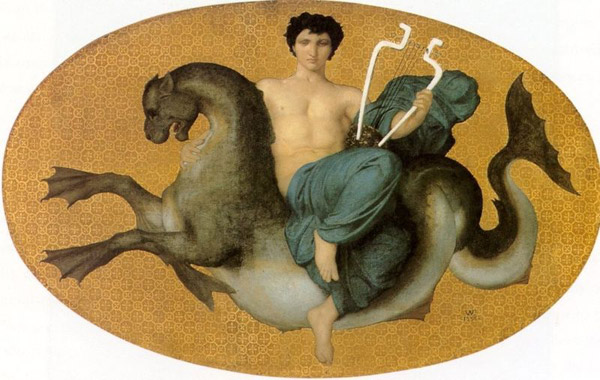
Poseidon’s Mounts
These proud looking animals were used in the service of Poseidon, who is not only the God of the sea, but the God of horses as well. Different myths spur different imagery where Poseidon and his mounts are concerned, sometimes he rides them and in others they draw his sea-chariot.
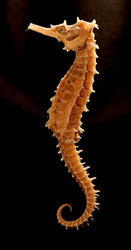
Image from Don Van Dyke
Although there haven’t been many actual sightings of these animals, their likeness can be found on the walls of temples, Roman baths, in fountains, & even decorating tomb walls.
Hippocampus Today
These days the term is used to refer to the seahorse, which is a very literal translation of the name.
Not quite the majestic beast we imaging pulling Poseidon’s chariot, but a graceful, mysterious animal nonetheless.
It is easy to see where the myths came from, the seahorse of today looks strikingly similar to our terrestrial equines. Perhaps seahorses used to grow very, very large and that is where the story of Poseidon’s trusty Hippocampus came from.
Not Always on the Good Side
Although we think of the horse as a noble and good creatures, (like pegasus) not all horses of mythology are friendly ones. There are a few that everyone should keep an eye out for, like the Tikbalang & the Kelpie. Both of which are horse-like creatures and not to be trusted.
Today I saw for sale a Netune riding a Hippocampus statue on Facebook. His name is Joe Nouveau. I looked up the name as I thought it was a part of the brain and located your page. Hope you like Joe’s statue. Pam
i am doing a reasearch project on hippocampi and i can not find out a timeline or when they were first sighted do you know of any good sights?
*sites*
Interested if you found out your timeline. My daughter is 10yrs old and has to get information on the Hippocampus and we have not found out the date of creation, very frustrating!! Any help would be great.
Thanks
Carol
A Hippocampus is the logo of the Historic Albany Carousel Project in Albany Oregon. It was one of the first animals finished. See their web page at: http://www.facebook.com/AlbanyHistoricCarousel
Do ya’ll know who wrote this site? I am doing a research paper and I have to cite it in my essay!
help i am doing a research assignment and i need info . i’ve tried lots of sites and i can’t find ANYTHING relevent
hey guys i need some help to find some info on my project. where can i find info????
Same! I can’t believe it
Read The Percy Jackson Series by Rick Rioradan to find out more( hint it’s the Sea of Monsters Book.)
That was awesome
why do you people waist your time. If you are not going to tell the truth.This doesn’t make any sense if you use the basic sientific logic some of these are right and some are wrong if you are going to post things post what is right and stop waisting your life i can’t stand when people do that. If you know it doesn’t make sense dont post it it will make you look stupid. If you dont know why it makes you look stupid because when you post something it tels who you are it may not tell everything but it will tell enough to make your name look stupid.